ECONOVAPACK
Kraft Takeaway Boxes Wholesale
Compare kraft paper food boxes, trays and containers for restaurant takeaway and foodservice distribution.
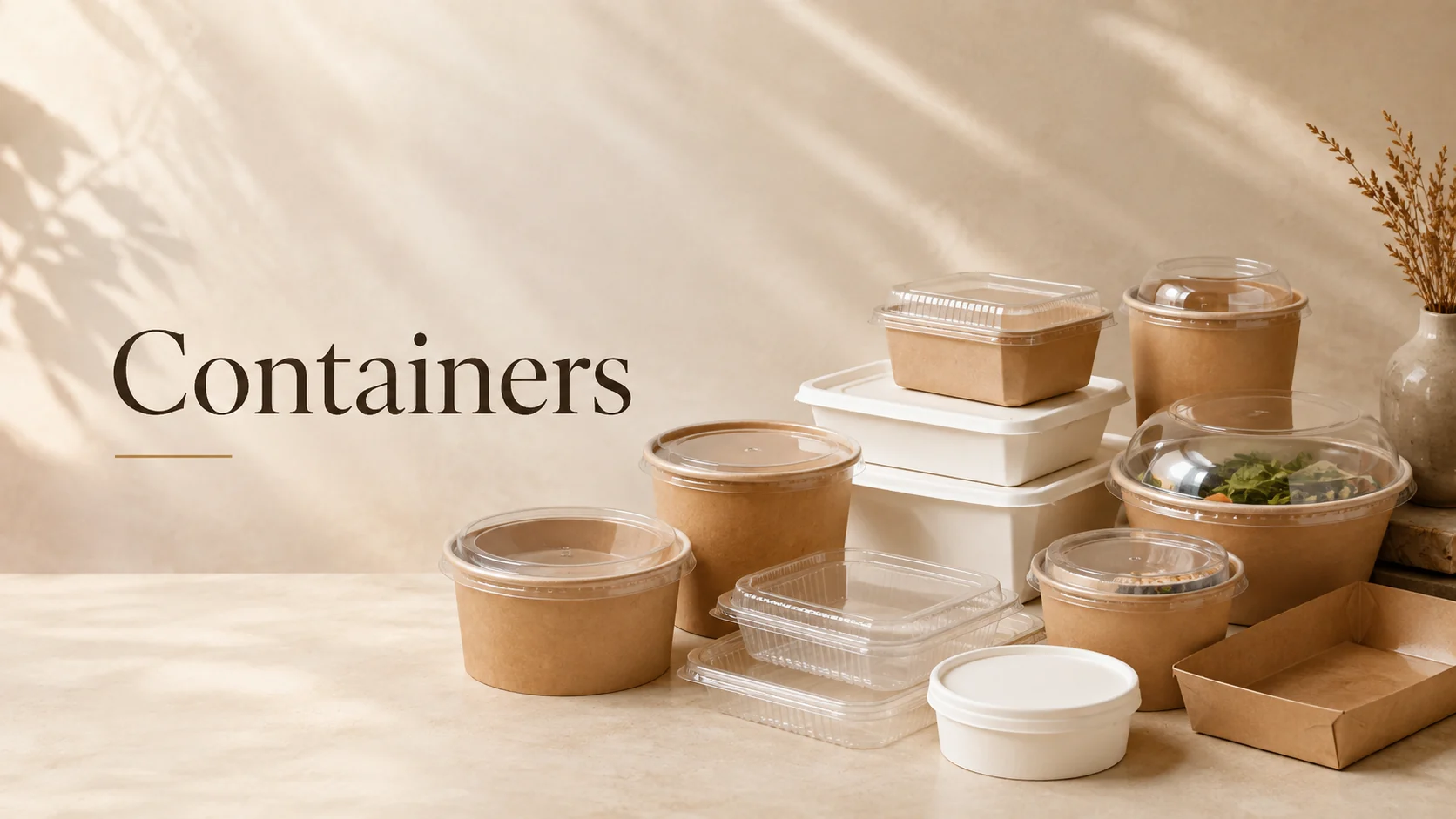
Round bowls, square containers and food tubs for salads, noodles, soups and prepared meals.
Send the required size, estimated quantity, destination, custom printing and target use.
Confirm samples, final specification, carton packing, lead time and destination-market documentation.
Inquiry path
Send one clear request
Share product type, size, quantity, printing needs, destination and target use. Our sales team will reply with practical sourcing options.
Selection guide
Choosing kraft takeaway boxes by menu, lining and size
Kraft takeaway boxes cover two constructions that buyers often confuse: fold-up paperboard boxes and tubs for dry or short-hold food, and lined boxes and soup cups for wet, hot or oily dishes. The lining decision comes first. An unlined kraft box is right for bakery items, fried food served immediately and dry snacks; a PE-, PLA- or aqueous-lined construction is what carries curries, soups and sauced noodles through a delivery run. Name the lining in the specification — it changes barrier performance, end-of-life wording and price basis all at once.
Size by filled volume, not by the box name. Mainstream takeaway boxes run between roughly 500 and 2,000 ml, with common footprints around 160 × 130 mm at the 750 ml class and 175 × 140 mm at 1,000 ml; round kraft bowls run about 500–1,500 ml. Test with your actual portions: headspace decides whether a lid seats properly, and a brim-filled box fails in the delivery bag even when nominal capacity matches the recipe.
Lids are part of the same specification: paper lids, PET or PP lids and fold-in flaps behave differently under steam and stacking. Approve box and lid as one system on samples, then record paper grade — kraft board here commonly sits around 300–337 gsm — lining, dimensions and carton data in the frozen specification.
Menu item and sauce level, filled volume in ml, lining type (none, PE, PLA or aqueous), lid system, paper grade and holding time — in that order.
Boxes typically 500–2,000 ml per carton counts around 200 pcs; round bowls 500–1,500 ml around 300 pcs per carton. Treat platform figures as a starting frame; the approved sample fixes the real values.
A lined box is assessed as a lined construction: PE lining is not compostable, and any compostable or PFAS wording is confirmed per exact construction and destination before use.
FAQ
Kraft Takeaway Boxes Wholesale — frequently asked questions
The minimum is 10,000 pcs per SKU/specification — one size, one lining, one artwork. Different sizes cannot be combined to reach the minimum, but several approved box SKUs can be consolidated in one container, and each item's loading is calculated from its own carton dimensions and CBM.
Wet and hot dishes need a lined construction: PE lining is the conventional barrier, PLA and aqueous coatings are the alternative routes buyers ask about for end-of-life reasons. Whichever route is chosen, it is named in the specification and proven with your food at serving temperature for the real holding time on samples.
The mainstream range runs from about 500 ml snack formats to 2,000 ml sharing boxes, with common footprints near 160 × 130 mm (750 ml class) and 175 × 140 mm (1,000 ml class), plus round bowls from 500 to 1,500 ml. Confirm usable volume with your portions, because nominal and brimful capacity differ.
Yes. Custom printing is a standard route for this family: share vector artwork and color references, approve a printed sample — a sample or setup charge may apply and is quoted in advance — and freeze the artwork version and carton mark in the written specification before production begins.
It depends on the complete construction. An unlined kraft box and a lined box are different products for end-of-life purposes, and a PE lining is not compostable. Any compostable claim needs third-party certification of the exact construction under EN 13432 or ASTM D6868, confirmed per SKU and destination before the wording is used.
It is calculated from the final carton: carton CBM equals length × width × height in metres, and cartons per container equal the usable volume — about 25–28 CBM for a 20ft, 65–70 CBM for a 40HQ — divided by the carton CBM. The confirmed figure, including pallets, is stated in the quotation.
Yes. Standard samples are free of charge; the buyer covers the international courier cost. Test the box and its lid as one system with your real menu — fill weight, steam, stacking in the delivery bag and the full holding time — and record the result in the approved specification.