Material guide for buyers
What Is Bagasse? Sugarcane Fiber Explained for Food Packaging Buyers
We work with bagasse every week, and we still hear the same first question: what is bagasse, actually? The short version is that bagasse is the dry fiber left after sugarcane stalks are crushed to extract their juice. We collect that fiber, pulp it, and mold it into the clamshells, bowls, plates, trays and cutlery that foodservice buyers use as an alternative to plastic and coated paper. This guide explains where the fiber comes from, how we turn it into tableware, how it differs from wood-pulp paper and PLA, and how we check a compostable claim before we let it appear on a specification.
The short answer first
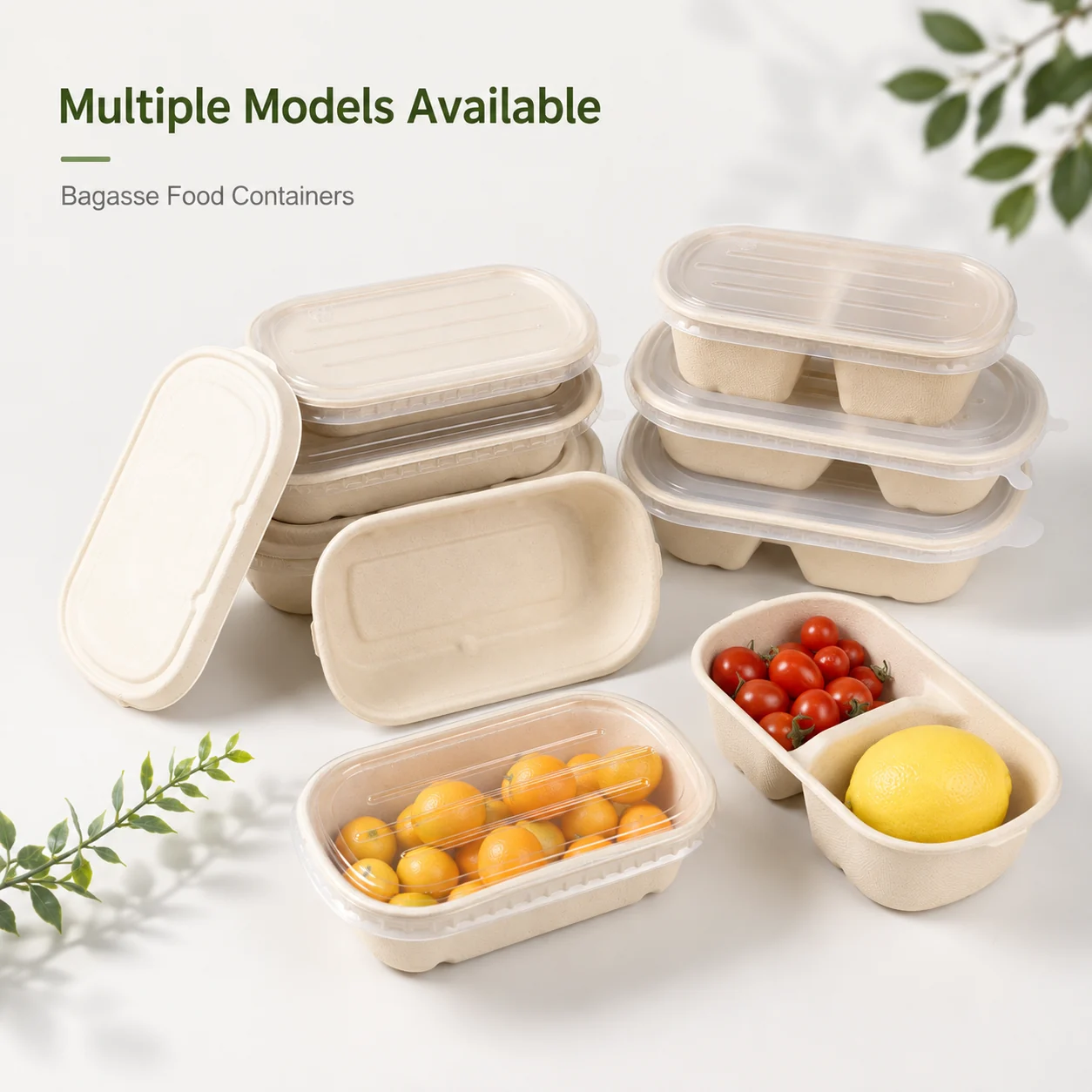
Bagasse is sugarcane fiber, not a plastic and not a coating. After a sugar mill crushes cane stalks and extracts the juice for sugar production, a fibrous residue remains. That residue is bagasse. When we clean it, pulp it with water and mold it under heat and pressure, it forms a rigid, paper-like material that holds its shape without a plastic film. We use it for hinged clamshell containers, bowls, plates, trays and cutlery — the items in our bagasse food packaging range.
Two points matter for buyers. First, bagasse starts as an agricultural residue, so it uses a fiber stream that already exists rather than a tree harvested for pulp or a resin synthesized for molding. Second, the word “bagasse” on its own proves nothing about compostability, grease resistance or food-contact compliance. Those are properties of a finished item — its exact formulation, barrier route, size and destination — and we confirm them per exact SKU before we state them, the same discipline we apply in our compostability guide and our PFAS-free guide.
1. Where bagasse comes from
Sugarcane grows in tall stalks. At the mill, rollers crush the stalks and the juice is extracted for sugar and, in some regions, ethanol. What leaves the rollers is a damp mat of short cellulose fibers, fragments of rind and residual sugars. Fresh bagasse is bulky and wet, and mills have traditionally burned much of it as boiler fuel. The portion diverted to pulp production is washed, screened and cleaned to remove sand, residual sugar and loose particles, because anything left in the fiber shows up later as a weak spot, an odour or a colour variation in the finished item.
The cleaned fiber is a pulp, not a finished material. Its colour is naturally light brown; the pale cream colour buyers usually see comes from bleaching or washing grades, and the unbleached grade keeps a natural tan tone. When we specify a bagasse item, we therefore record the colour grade — natural or bleached — alongside size and construction, because the two grades are different specifications even when the shape is identical.
2. How we turn bagasse fiber into tableware
We make molded-fiber tableware in four broad steps. First, we prepare the pulp: cleaned bagasse fiber is dispersed in water and refined so the fibers separate and bond evenly. Where a specification needs a grease or water barrier, the barrier approach is decided at this stage — for example an in-pulp barrier additive, a surface treatment, or no added barrier at all where forming density alone is enough. That decision belongs in the specification, because it affects both performance and the end-of-life claim, as we explain in the PFAS section below.
Second, we form the item. A mold draws the pulp slurry onto a shaped screen, water is pulled away by vacuum, and a wet fiber shell in the shape of a clamshell, bowl or plate remains. Third, we press and dry it: heated molds compress the shell, remove the remaining water and set the final dimensions, rim and hinge. This hot-pressing step is what gives a molded bagasse item its rigidity and its clean edge. Fourth, we trim, inspect and pack the finished items, checking dimensions, weight, closure fit and surface defects by lot before they are cartoned for export.
The practical consequence for buyers is that a bagasse item is defined by more than its outline drawing. Two clamshells with the same length, width and height can differ in single-item weight, wall thickness, compartment layout and barrier route — and those differences decide how the item behaves with hot, oily or wet food. That is why our product pages record construction and weight per SKU, and why we ask buyers to test the exact item with their real food, temperature and holding time instead of judging from a photo.
Material comparison
3. Bagasse vs wood-pulp paper vs PLA: what actually differs
Buyers usually meet bagasse while comparing it with two familiar materials: molded or formed wood-pulp paper, and PLA, the plant-based plastic used for clear cups and cutlery. All three can be described with the word “plant-based”, which is exactly why that word is not a useful specification. The table below compares the three on the points that change a buying decision.
| Point of comparison | Bagasse (sugarcane fiber) | Wood-pulp paper | PLA |
|---|---|---|---|
| Feedstock | Fiber residue left after sugarcane is crushed for juice; an existing agricultural by-product stream. | Wood fiber pulped from trees, virgin or recycled depending on grade. | A plastic resin made by fermenting plant sugars and polymerising the result; supplied as pellets, not fiber. |
| How the item is made | Pulp is molded on a shaped screen, then hot-pressed and dried into a rigid fiber item. | Paper sheet is formed, coated or laminated where a barrier is needed, then cut, folded or pressed into shape. | Resin is injection-molded, thermoformed or extruded like a conventional plastic. |
| Typical items in our range | Clamshells, bowls, plates, trays and molded-fiber cutlery. | Cups, soup bowls, kraft takeaway boxes, bags and food trays, usually with a lining for liquids. | Clear cold cups and lids, and CPLA cutlery where heat resistance is specified. |
| Barrier for grease and water | Comes from fiber density, an in-pulp additive or a surface route chosen per SKU; the route must be named in the specification. | Usually comes from a PE, PLA or water-based lining; the lining decides much of the end-of-life position. | The resin itself resists water and grease without a separate lining. |
| Look and feel | Matte, rigid, slightly textured fiber surface; natural or bleached colour grades. | Smooth paper surface, printable over large areas; stiffness depends on board grade and lining. | Smooth and, for cups, transparent; behaves and feels like plastic because it is one. |
| End-of-life starting point | A fiber item with no plastic film; compostability still depends on the finished item and its barrier route, checked per SKU. | Depends on the lining: an unlined paper item and a PE-lined cup follow different routes. | Designed for industrial composting routes where they exist; it is not a fiber and does not behave like paper in recycling. |
Our bagasse vs plastic vs PE-lined paper comparison applies the same logic to takeout containers specifically, including closures and export packing. The rule we work by is simple: choose the material by the food, the holding time and the claim the destination market will accept — not by the feedstock story alone.
4. What bagasse does well, and where we tell buyers to be careful
We recommend bagasse where its structure helps: rigid items that must hold their shape around hot food, hinged containers that need a working hinge without a separate lid, and ranges where a buyer wants one fiber material across plates, bowls and trays. A molded item also stacks and packs predictably, which matters when we calculate cartons and container loading from real carton data rather than estimates.
We also tell buyers where to test carefully. Grease and water resistance depend on the barrier route and the holding time: an item that holds a dry bakery product all day is a different specification from one that must hold a hot, oily meal for an hour. Thin walls and low single-item weight reduce material use but shorten that hold time. Lids are a separate question as well — some bagasse containers close with their own hinged fiber lid, while others pair with a separate PET or fiber lid whose fit must be confirmed for the exact model. None of these points can be settled by the word “bagasse”; they are settled by a sample test with the buyer’s own food and service conditions, which is why standard samples are free under our sample policy and the buyer covers the courier.
5. Compostability: what we check before the word is used
Bagasse is a fiber, and fiber is biodegradable in principle. A compostable claim for a finished food package is a narrower, testable statement, and we treat it that way. EN 13432 in Europe and ASTM D6400 in the United States are standards, not certificates: a finished item is tested by a third-party body and certified only for the exact product, formulation and SKU named on the certificate. A material name cannot transfer that result to a whole range. Where a bagasse item carries a plastic coating or film, the applicable route is normally the one for plastic-coated paper and board rather than the plain standard, so the construction must be stated before the standard is chosen.
The checks behind those standards cover four things: what the item is made of, how completely it biodegrades under controlled composting conditions, how completely it breaks down into small fragments, and whether the resulting compost harms plant growth. A separate gate now sits alongside them: certification schemes for compostable products require no intentionally added fluorinated chemicals and a total fluorine result below 100 ppm, with a formulation review. An item can therefore pass the breakdown tests and still fail on its grease-proofing route — which is why we ask for the compostability position and the PFAS position separately, in writing, for the exact SKU.
Our working rule, stated on our food-contact documents page, is that environmental claims and supporting documents are checked by exact SKU and destination. We do not publish certificate files or numbers on this website; where a buyer needs them for supplier qualification or a quotation, we review the documents confidentially for the selected product, material and supply route. If a document does not cover the item being quoted, we say so instead of letting the claim travel.
6. How we supply bagasse packaging
We supply bagasse clamshells, bowls, plates, trays and cutlery as part of a wider food packaging range that also covers paper and PET, so a distributor can consolidate fiber, paper and plastic items through one export contact in Ningbo. Our family manufacturing and export roots date back to 1993. The minimum bulk order is 10,000 pcs per SKU/specification, and quantities from different SKUs or specifications cannot be combined to meet that minimum; sample quantities and pieces per carton are counted separately from the bulk MOQ. Bulk dispatch is 10–30 days depending on quantity, printing and packing, confirmed before an order is placed, with Ningbo, Shanghai and Qingdao as the usual ports and EXW, FOB, CIF and DDP available as negotiable terms.
For US distributors, we check environmental claims and supporting documents by exact SKU and destination before quotation, so a range can be built around the rules of the state it will be sold in. If you are building a bagasse range, send us the item, size, barrier need, quantity per SKU and destination through our RFQ form, and we will confirm the specification, the sample route and the documents that apply before artwork or packing is frozen.
Frequently asked questions
What is bagasse made from? Bagasse is the fiber that remains after sugarcane stalks are crushed to extract their juice. We clean and pulp that fiber, then mold and hot-press it into rigid tableware.
Is bagasse the same as paper? Both are plant fiber, but they start differently and are formed differently. Paper begins as a flat sheet that is then cut, folded or pressed, usually with a lining for liquids; bagasse pulp is molded directly into the final three-dimensional shape and pressed dry.
Is bagasse compostable? The fiber is biodegradable, but a compostable claim belongs to a finished item that has been tested and certified for its exact formulation and SKU under a standard such as EN 13432 or ASTM D6400. We confirm the position per exact SKU and destination before the word is used.
Can bagasse hold hot and oily food? It depends on the barrier route, wall weight and holding time in the specification. We ask buyers to test the exact item with their real food at serving temperature; a sample test settles what a material name cannot.
What is the minimum order for bagasse items? The minimum bulk order is 10,000 pcs per SKU/specification, and different SKUs or specifications cannot be combined to meet it. Sample quantities are separate from the bulk MOQ.
Do bagasse items contain PFAS? That depends on the grease-resistance route of the exact SKU. Certification schemes require no intentionally added fluorinated chemicals and total fluorine below 100 ppm; we confirm the formulation and, where a threshold applies, the test report for the exact item, as our PFAS-free guide explains.